
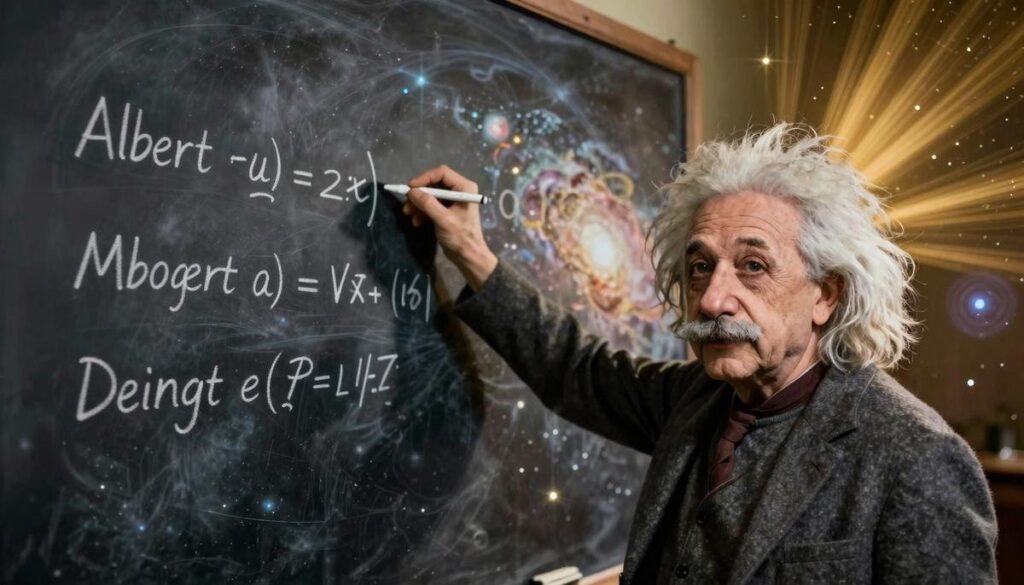
Albert Einstein God Does Not Play Dice: The Cosmic Order Behind Your Life Purpose
When Albert Einstein declared that God does not play dice with the universe, he was not merely debating quantum mechanics. He was expressing a profound truth about cosmic order that resonates deeply with how we understand our own lives. The Albert Einstein god does not play dice philosophy reveals that beneath apparent chaos, there exists an elegant structure guiding everything from subatomic particles to human destiny. Understanding this concept can transform how you approach decisions, setbacks, and your ultimate life purpose.
The Origin of Einstein Famous Quote and Its Deeper Meaning
Einstein made his famous statement in a 1926 letter to Max Born, one of the pioneers of quantum mechanics. The probabilistic nature of quantum theory troubled Einstein because he believed the universe operates on deterministic principles. For Einstein, the idea that particles exist in probability waves until observed contradicted the elegant order he saw in nature. This was not a rejection of science but an affirmation that deeper laws govern reality. The Albert Einstein god does not play dice worldview suggests that what appears random is simply our limited perception of a greater pattern we have not yet comprehended.
This perspective has profound implications for how we live our lives. If the universe operates on ordered principles rather than pure chance, then your existence is not accidental. Every experience, every encounter, and every challenge carries meaning within a larger framework. The Albert Einstein god does not play dice philosophy invites you to look beyond surface-level chaos and trust that there is an underlying coherence to your life journey.
Cosmic Order and the Architecture of Your Life
The concept of cosmic order extends far beyond physics. Throughout human history, philosophers, theologians, and scientists have recognized patterns that suggest intelligent design or inherent structure in existence. From the Fibonacci sequence in nature to the precise orbital mechanics of planets, the universe demonstrates remarkable organization. When we apply this understanding to our personal lives, we begin to see that our choices, relationships, and circumstances are not random events but interconnected elements of a larger tapestry.
Recognizing Patterns in Your Personal History
Take a moment to reflect on your life journey. What initially appeared as setbacks often led to unexpected opportunities. What seemed like chance encounters transformed into pivotal relationships. The Albert Einstein god does not play dice perspective encourages you to examine these moments not as coincidences but as meaningful elements of your personal narrative. By recognizing patterns, you gain the ability to make more informed decisions and navigate future challenges with greater confidence.
The Difference Between Determinism and Destiny
It is important to distinguish between fatalistic determinism and the empowering concept of cosmic order. Einstein was not suggesting that humans have no free will. Rather, he was pointing out that the universe operates within lawful frameworks that we can understand and work with. Your life is not a predetermined script but a composition where you are both the musician and the conductor, playing within the harmonic laws of existence.
How Belief in Cosmic Order Transforms Your Daily Life
Adopting the Albert Einstein god does not play dice mindset fundamentally changes how you approach everyday challenges. When you believe that there is order beneath chaos, you respond to difficulties differently. Instead of feeling victimized by circumstances, you begin asking what lesson or opportunity the situation presents. This shift in perspective is not naive optimism but a sophisticated understanding that life operates on principles that reward awareness, persistence, and alignment with natural laws.
- Trust the Process: When you believe in cosmic order, you develop patience with your timeline and trust that things unfold as they should.
- Seek Meaning in Challenges: Every obstacle becomes a teacher rather than a punishment, revealing hidden pathways forward.
- Make Aligned Decisions: You begin choosing actions that resonate with your deeper purpose rather than reacting from fear.
- Develop Intuitive Wisdom: Recognizing patterns sharpens your ability to sense what path aligns with your highest good.
- Cultivate Inner Peace: Trusting in cosmic order reduces anxiety about outcomes and allows you to focus on the present moment.
The Science Behind Universal Order and Human Experience
Modern science continues to reveal the extraordinary order underlying existence. From the fine-tuning of physical constants that allow life to exist, to the self-organizing principles observed in complex systems, evidence of cosmic order appears at every scale. Chaos theory, despite its name, demonstrates that even seemingly random systems follow underlying patterns called attractors. This scientific reality supports the Albert Einstein god does not play dice intuition that the universe is fundamentally coherent rather than arbitrary.
| Aspect of Order | Scientific Basis | Life Application |
|---|---|---|
| Physical Constants | Fine-tuning allows stable matter and life | Your existence is not accidental |
| Chaos Theory | Strange attractors create patterns in complex systems | Life events follow underlying patterns |
| Quantum Entanglement | Particles remain connected across distance | Relationships carry deeper significance |
| Self-Organization | Complex systems spontaneously create order | Growth emerges from apparent chaos |
“The most incomprehensible thing about the universe is that it is comprehensible.” — Albert Einstein
Living in Alignment with Cosmic Order
Understanding that the universe operates on ordered principles is only the first step. The real transformation occurs when you align your daily actions with this awareness. Living in alignment means making choices that resonate with your authentic self and the natural flow of existence. It requires developing sensitivity to the patterns and synchronicities that guide you toward your highest potential.
This alignment is not passive surrender but active participation in co-creating your reality. When you understand that the Albert Einstein god does not play dice principle applies to your life, you become both more intentional in your choices and more trusting of the outcomes. You learn to distinguish between forcing outcomes and allowing them to unfold naturally, developing a sophisticated navigation system for life complexities.
Discussion Points on Albert Einstein God Does Not Play Dice Philosophy
1. How Does Cosmic Order Influence Personal Decision-Making: When you trust that life follows ordered principles, you approach decisions with both rational analysis and intuitive wisdom, creating a balanced framework for choice.
2. The Role of Synchronicity in Recognizing Life Patterns: Meaningful coincidences serve as signposts that confirm you are on the right path, reinforcing your trust in the Albert Einstein god does not play dice worldview.
3. Balancing Personal Responsibility with Trust in Universal Order: You remain the author of your life while acknowledging that larger forces support your journey toward fulfillment.
4. Why the Illusion of Randomness Prevents Growth: Believing life is random leads to reactive living, while recognizing order empowers purposeful action aligned with your deepest values.
5. Practical Steps to Align Your Life with Cosmic Principles: Daily practices including meditation, journaling, and mindful awareness help you recognize and follow the patterns guiding your existence.
Conclusion: Embracing the Order Beneath the Surface
The Albert Einstein god does not play dice philosophy offers a powerful lens through which to view your existence. It reminds you that beneath apparent chaos lies an elegant order waiting to be discovered and embraced. This understanding transforms how you approach every aspect of life, from daily decisions to long-term purpose. When you trust in cosmic order, you develop the courage to pursue your authentic path and the wisdom to recognize the patterns that guide you forward. Explore more about how universal principles shape human experience at IXP Life, where we help you discover the deeper meaning behind your everyday existence.
FAQ: Albert Einstein God Does Not Play Dice and Your Life
What did Einstein mean by God does not play dice?
Einstein was expressing his belief that the universe operates on deterministic principles rather than pure probability. He rejected the idea that at the fundamental level, reality is random, preferring to believe that deeper laws govern quantum phenomena.
How does this philosophy apply to everyday life decisions?
If you believe the universe operates on ordered principles, you approach decisions with greater confidence and less anxiety. You trust that your choices matter and that following your authentic path leads to meaningful outcomes rather than random results.
Does believing in cosmic order mean giving up free will?
No, understanding cosmic order is not fatalism. Just as a musician works within harmonic principles to create beautiful music, you exercise free will within the lawful framework of existence. Your choices are real and meaningful within the cosmic structure.
Can science and spirituality coexist in this worldview?
Absolutely. Einstein himself was deeply spiritual, though not religious in a conventional sense. The recognition of cosmic order bridges scientific understanding and spiritual experience, suggesting they are complementary ways of comprehending the same underlying reality.
Ready to explore how cosmic order shapes your personal journey? Visit IXP Life today and discover the transformative power of understanding your place within the universal pattern.
Related Articles on Cosmic Order and Universal Patterns
Deepen your understanding of cosmic order and how universal principles shape your life by exploring our related articles:
- Quantum Physics and Destiny: How Einstein Universe Reveals Your Life Path — Explore the quantum foundations of destiny and how universal laws influence your personal journey.
- The Illusion of Randomness: Why Nothing in Life Is Truly Accidental — Discover why apparent chaos conceals meaningful patterns guiding your existence.
- Faith vs Science: How Belief in Cosmic Order Shapes Your Decisions — Learn how faith and science converge to create a powerful decision-making framework.